Pure TunerA tuner for historical temperaments and microtonal scales
Almost every tuner measures against equal temperament. If you tune a harpsichord to Werckmeister, play meantone in a consort, sing pure thirds in a choir or own a 19-tone guitar, that is of little use. Pure Tuner measures against the tuning you actually play in.
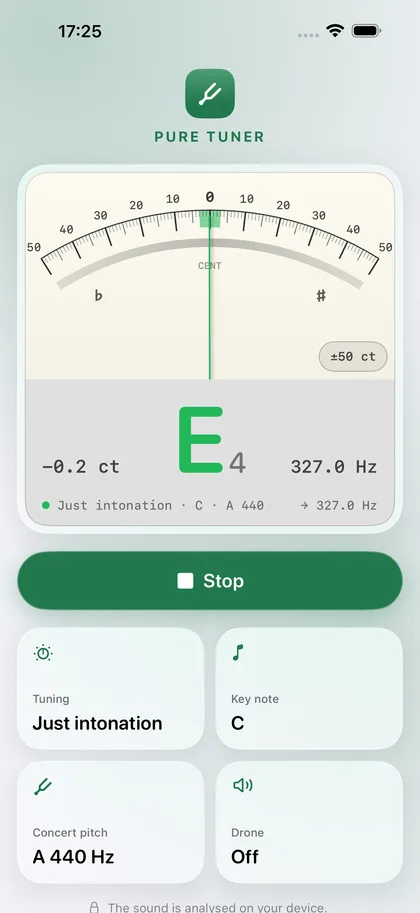
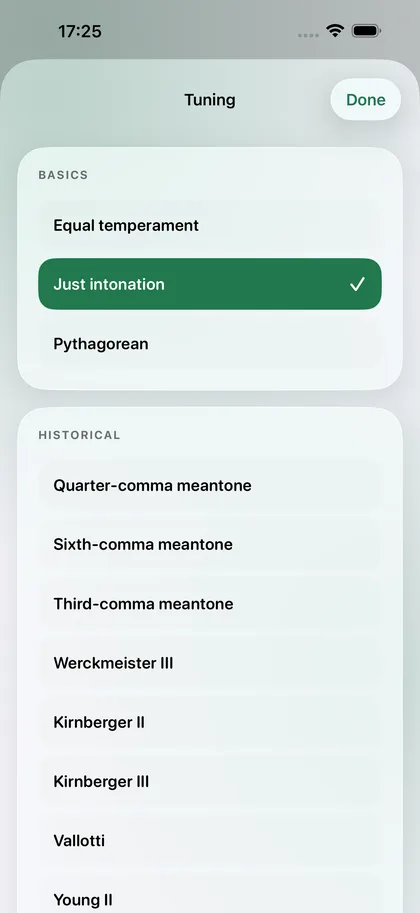
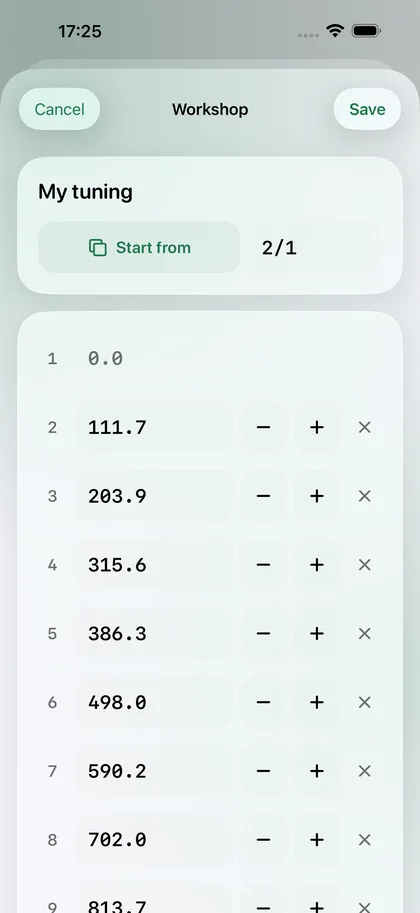
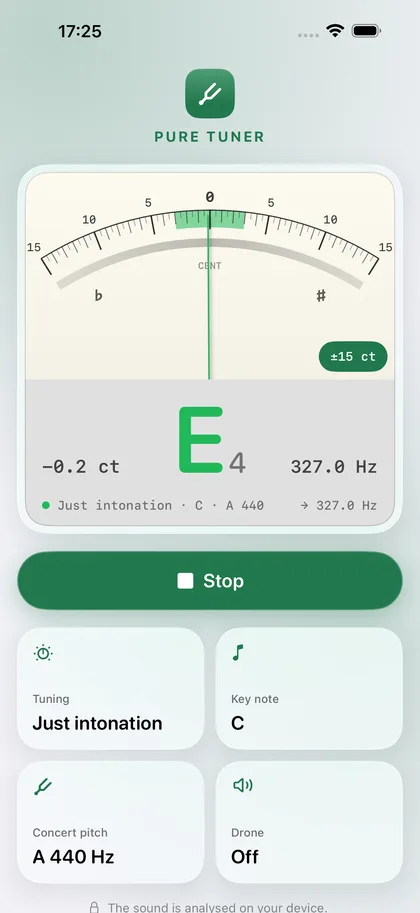
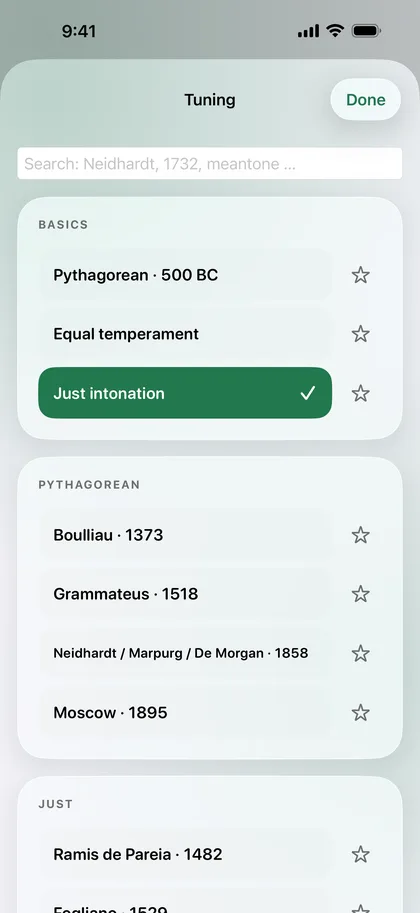
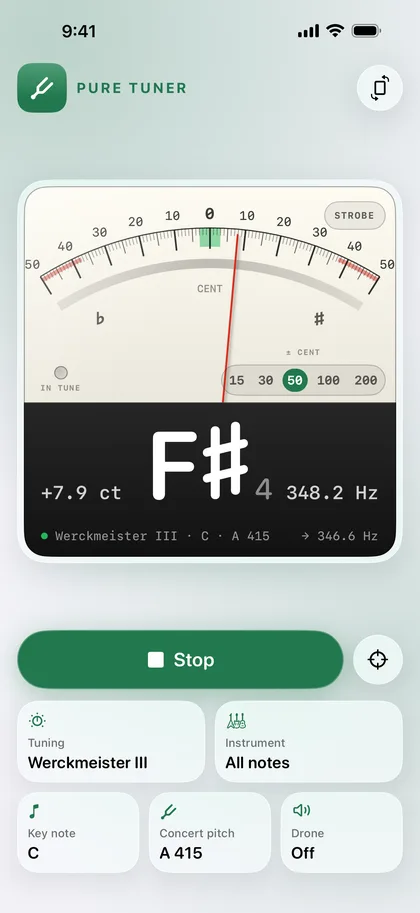
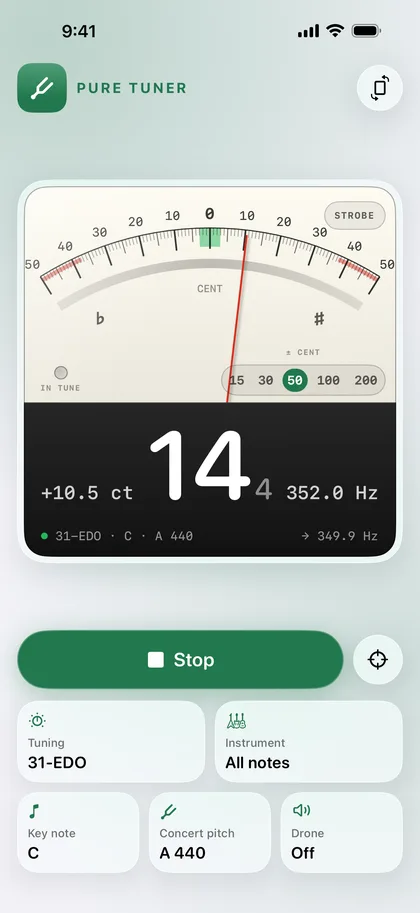
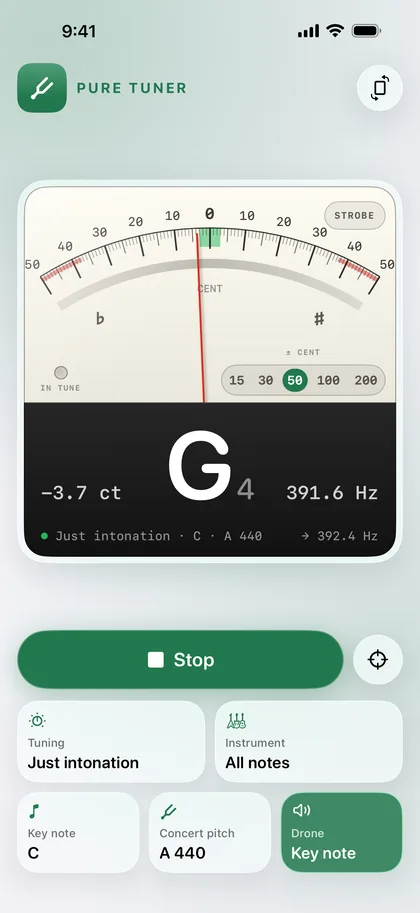
A pure third, measured exactly.The strobe on the whole screen.A lute in meantone, course by course.Lutes, viols, strings and guitars.Tunings, grouped in families.Werckmeister III at A 415 for baroque.19, 31 or 53 tones to the octave.A drone on the key note to tune against.Your own tunings in the workshop.Five ranges, down to ±15 cents.
Use cases
01
Early music
For harpsichord, viol or lute: Werckmeister III, Vallotti, Kirnberger or quarter-comma meantone, with a reference pitch of 415 Hz or any other value between 380 and 480 Hz.
02
Choirs, strings and winds
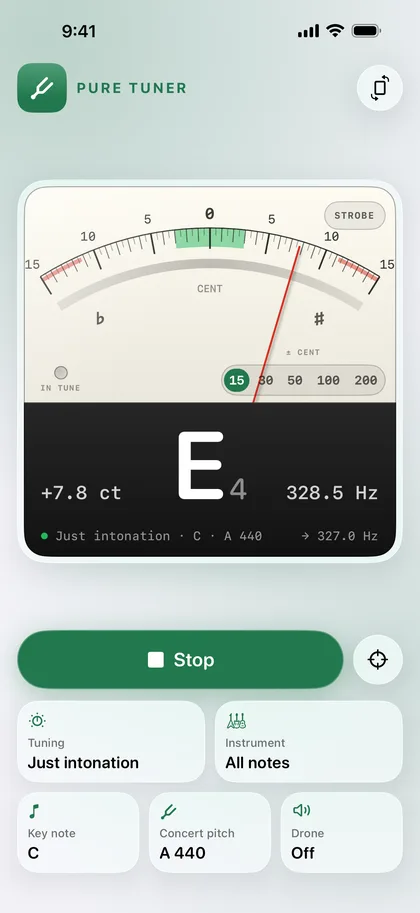
A pure major third is about 14 cents lower than on the piano. Pure Tuner shows just intonation in any key. With the drone on the key note you can also tune by ear.
03
Microtonal instruments
For 19-tone guitars, 31 equal divisions, 22 shruti or Bohlen–Pierce. You can enter your own tunings in cents or as frequency ratios and import them as Scala files.
Features
Free
€0
A display in the style of an analogue meter: long, thin needle, one tick per cent, a green zone of ±3 cents — or a strobe that shows a tenth of a cent, also on the whole screen
Five ranges, from ±200 to ±15 cents, and a lamp that lights when the note is in tune
The whole tuner on one screen, upright or on its side; the orientation can be fixed
Instruments with their open strings: renaissance lute, vihuela, theorbo, baroque guitar, viols, violin family, guitar in six tunings, bass, mandolin, ukulele, banjo, bouzouki, charango, oud, bağlama, sitar, pipa, erhu, nyckelharpa and more. The tuner finds the string you play and ticks each course once it is in tune
Only this note: switch off the automatic recognition and choose the note yourself, a step or an octave at a time. The tuner then listens for that note alone, for a quiet instrument or a loud room
Transposing instruments: in B flat, A, F, E flat or any key, the tuner shows the written note
Reference pitch anywhere from 380 to 480 Hz, typed to a hundredth (446.67). 392, 415, 430, 440, 442 and 466 Hz can be selected directly
Detects low notes in the correct octave, from a five-string bass to a piccolo
With plucked notes, the reading stays for a moment after the note has died away
One-time purchase “Every Tuning”
€9.99
Werckmeister III, Kirnberger II and III, Vallotti, Young II, Kellner, Bach/Lehman, Galilei's lute frets, and 64 more historical temperaments from Boulliau (1373) to Wendell (2003), sorted by family and year
Quarter-, sixth- and third-comma meantone, Pythagorean, just intonation in any key
Equal divisions of 17, 19, 22, 24, 31 and 53 tones, 22 shruti, Bohlen–Pierce
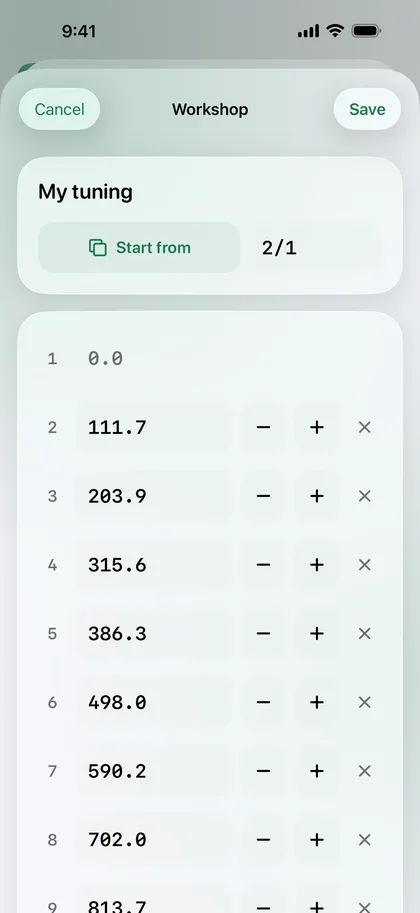
A workshop for your own tunings: enter cents or frequency ratios, starting from any existing tuning
Import and export of Scala files (.scl)
A drone on the key note, with a pure fifth if you like, for tuning by ear
When you change the tuning, the key note stays where it is. Only the other notes move. An instrument's open strings are measured in the tuning you chose: a lute in meantone has them in meantone.
Pitch detection runs on your device, nothing is recorded or transmitted. No account, no ads, no subscription.
Privacy
The app collects no data. Everything you open or create stays on your device until you share it yourself.
Microphone: Used only while the tuner is open. The sound is analysed in memory; nothing is recorded, stored or sent.