Pure CembaloLay a temperament on a harpsichord, or tune a kannel string by string, by the beats
Pure Cembalo leads you through tuning a harpsichord, clavichord, spinet, virginal or organ in a historical temperament, the way it is done by ear — and every kind of kannel and its kin, string by string.
Each key: the interval and its beats.A kannel, string by string.Every kannel and its kin.Every temperament, built from its rules.The chromatic kannel, laid like a keyboard.Your strings, in any key.Octaves out, each checked by its fifth.Between sets: what has moved.Another temperament: only the keys that move.
Use cases
01
The bearing
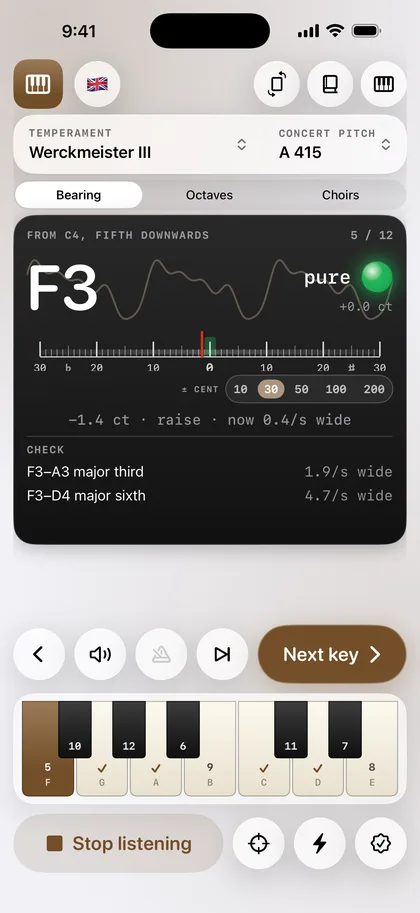
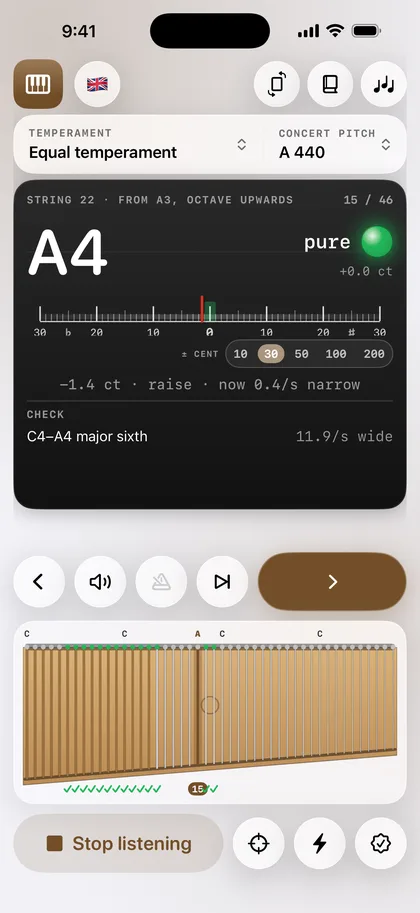
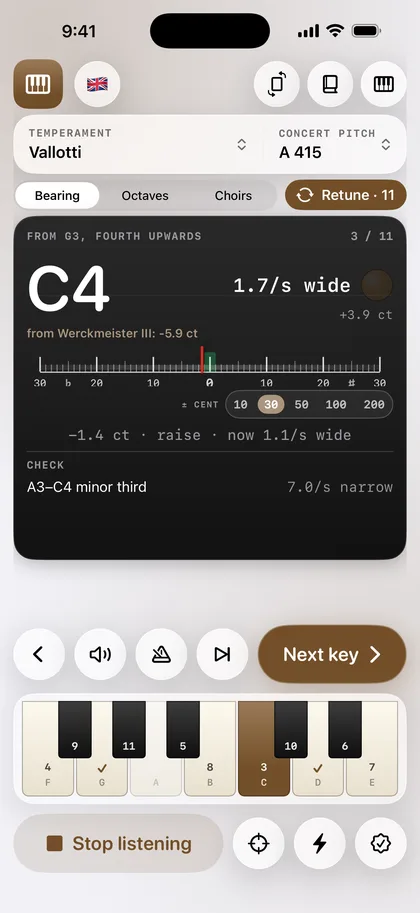
For each key: the fifth or fourth it is tuned by, how many beats a second it should make, a light and a click at that rate, and the microphone's reading in cents.
02
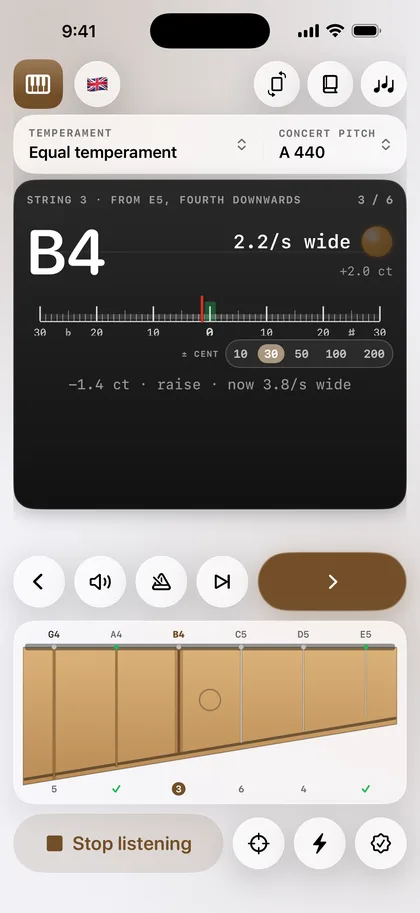
Kannel, kantele, kokle
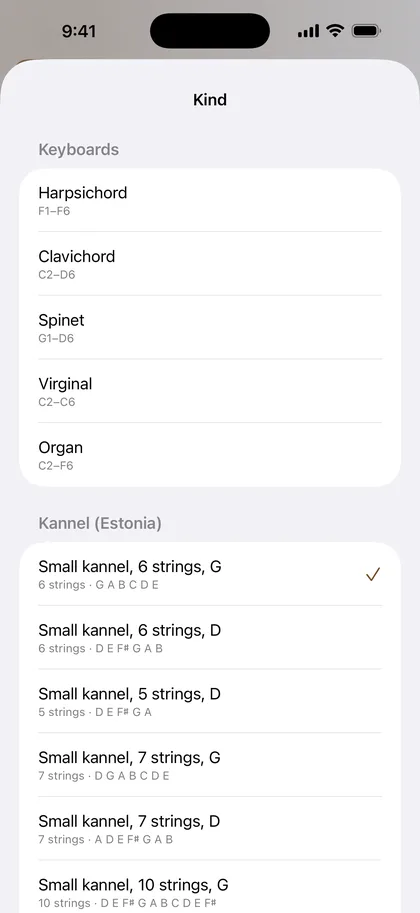
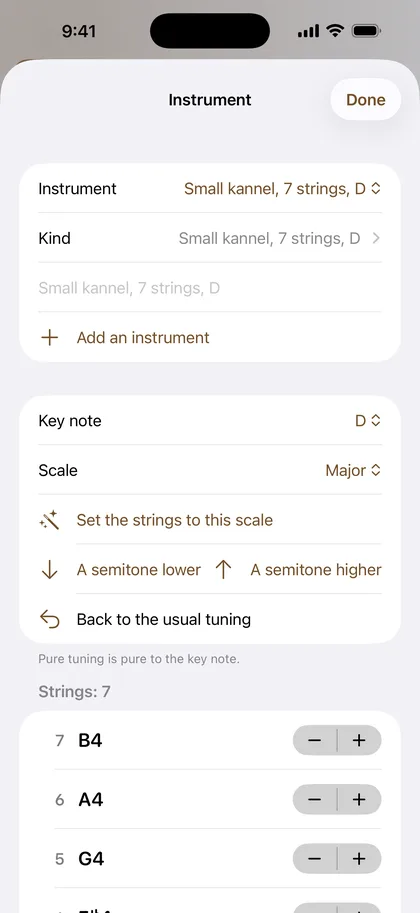
Every kind of kannel in its usual tuning, from the six-string small kannel to the chromatic concert kannel and the bowed hiiu kannel, and its kin from Finland, Latvia, Lithuania and Russia. Each string from one already in tune, by an octave, a fifth or a fourth. The app is also in Estonian.
03
Before the concert
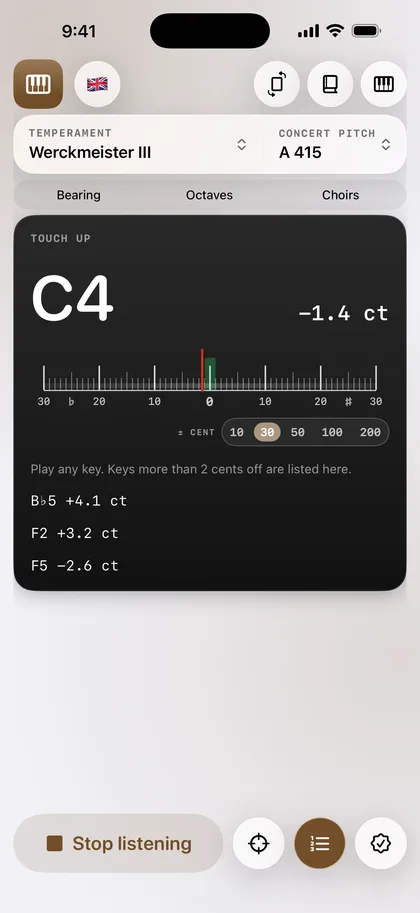
Touch-up between sets: play any key or string, and the app lists the ones that have moved.
Features
Free
€0
The interval it is tuned by — an octave, a fifth or a fourth from one already in tune — and how many beats a second it should make, narrow or wide
A light that flashes, and a click that ticks, at exactly that rate, to compare with what you hear
"Hear it": the interval played with its true beats
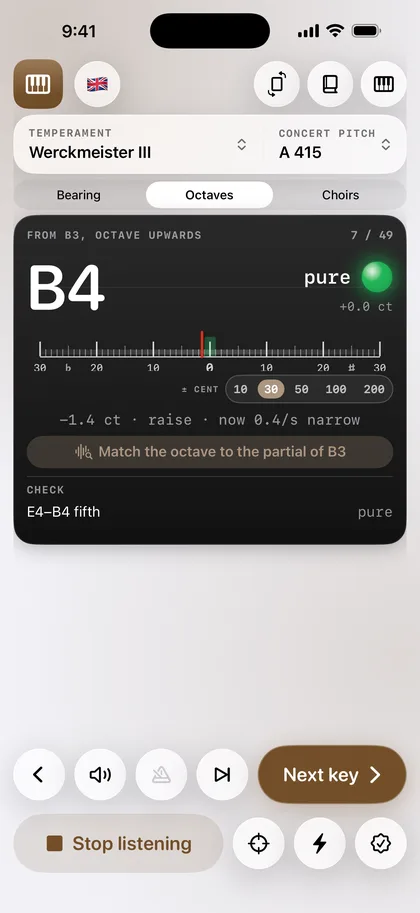
The microphone reads the string in cents and says whether to raise or lower it, and how fast the interval beats now
Thirds and sixths to the notes already tuned, with their beats, as the proof
The string's wave on a scope, standing still once it is in tune
Hands-free: the next key comes by itself once one has held in tune, and a page-turner pedal steps on and back
One-time purchase “Every Temperament”
€29.99
Small kannel with 5, 6, 7, 10 and 12 strings in G and D, the Kaarma kannel, the Setu kannel and the tunings Väisänen recorded in 1913, village and thumb-ring kannels, the folk kannel with 3 and 5 chords, the chromatic kannel with 46 and 50 strings, the bowed hiiu kannel
Set the key note and scale, move any string a semitone, add strings, move the whole instrument up or down
"Keep this pitch": tune to the instrument as it stands, when the season has moved it
One-time purchase “Every Temperament”
€29.99
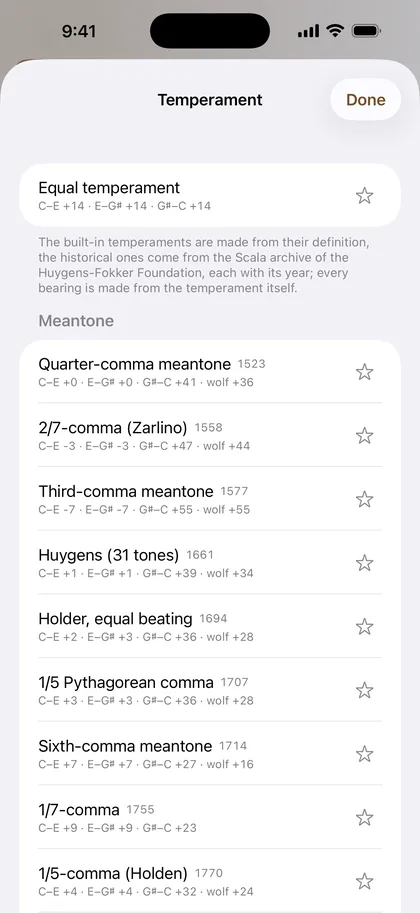
Pure tuning to the key note; sixth- and third-comma meantone, Werckmeister III, Kirnberger II and III, Vallotti, Young II, Kellner, Bach/Lehman, Pythagorean — each with its own plan, built from the temperament's definition
64 more historical temperaments from Boulliau (1373) to Wendell (2003): Neidhardt's large town and village, Rameau, d'Alembert, Prinz, Young, the meantones from 2/7 to 1/7 comma — sorted by family and year, each with its own bearing
Octaves matched to the partial the two strings share, so they come out as wide as the instrument wants them
Your own temperament from a Scala file
Retuning to another temperament between concerts: only the keys that move, each with how far
Second 8′ and 4′ choirs, key by key
Touch-up between sets: play any key or string, the app hears which one and lists those that have moved
Several instruments, and a tuning log
On a keyboard: the bearing in the middle octave from A, then the octaves out to both ends of the compass, each checked by its fifth. A pluck stands sharp for its first moment; the app reads the string after it has settled.
The app speaks English, German and Estonian.
Privacy
The app collects no data. Everything you open or create stays on your device until you share it yourself.
Microphone: Used only while the app listens. The sound is analysed in memory; nothing is recorded, stored or sent.
From A, set to the fork, fifths downwards (D, G, C, F, B♭, E♭) and then upwards (E, B, F♯, C♯, G♯), each as a fifth or a fourth so that it stays in the octave F to E. Then the octaves out to both ends.
Why does the reading wait after I pluck?
A plucked string sounds sharp for its first moment. The app reads it once it has settled, and takes the median of what follows.
In which order are a kannel's strings tuned?
The A nearest the fork first, then each string from one already in tune by the plainest interval there is: an octave, a fifth or a fourth before a third. A chromatic kannel is laid like a harpsichord, its middle octave first.
My kannel has drifted with the season. Must I pull it back to 440?
No. Pluck the first string and tap “Keep this pitch”: the rest is tuned to it.
How do I get the app in Estonian?
Estonian is not an iPhone system language, so the app follows your iPhone's language. Open Settings › Apps › Pure Cembalo › Language and choose Eesti.
I bought the upgrade, but it is locked again.
Tap “Restore purchase” on the purchase card in the app. A one-time purchase is tied to your Apple account and does not have to be paid for again.